
The government plans to introduce three bills in Parliament to address the removal of a prime minister, Union minister, chief minister, or minister of a Union Territory when arrested or detained on serious criminal charges.

The Congress party has accused the government of using women's reservation as a pretext to push through delimitation, arguing that the women's quota law should be implemented immediately based on the current Lok Sabha strength.

Congress MP K C Venugopal has submitted a privilege notice to Lok Sabha Speaker Om Birla against Prime Minister Narendra Modi, alleging breach of privilege during a recent address to the nation.

Shiv Sena-UBT leader Sanjay Raut has made significant claims regarding potential political shifts, suggesting Maharashtra CM Devendra Fadnavis might move to the Centre, paving the way for a new BJP chief minister in the state. Raut also announced a 'Ram Raksha Andolan' protest in Nagpur against alleged embezzlement at the Ayodhya Ram temple and commented on delimitation and activist Sonam Wangchuk's hunger strike.

Opposition parties, though resigned to the fact that they lack the numbers to defeat or stall the bill in the two Houses, have decided upon different tactics that they would employ to highlight their reasons for opposing it.

'They want to sabotage the caste census and bury Muslim backward classes, Hindu backward classes, Sikh backward classes and Buddhist backward classes.'
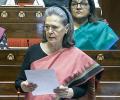
Congress Parliamentary Party chairperson Sonia Gandhi has criticized the Waqf (Amendment) Bill, calling it a 'brazen assault' on the Constitution and part of the BJP's strategy to keep society in a 'permanent state of polarization.' She also spoke out against the One Nation, One Election Bill, calling it a 'subversion of the Constitution.' Gandhi further accused the Modi government of ignoring the women's reservation bill and other demands for reservation, and of 'dragging the country into an abyss' where the Constitution will only exist on paper. She also criticized the government for limiting the speaking time of the Leader of the Opposition in Parliament and for not allowing discussions on important issues like the working of the defense and external affairs ministries and the challenges posed by China on the border.

Prime Minister Narendra Modi appealed to Lok Sabha members to vote for the women's reservation bill, emphasising the need to empower women and rectify decades of political inaction.
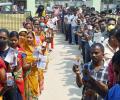
The proposed first constitutional amendment bill would deal with making provisions for holding Lok Sabha and state legislative assembly elections together.
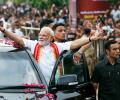
'Non-BJP state governments and their leaders, navigating today's political landscape, know well they have no clue what awaits around the corner.' 'The chances of charges pressed and oneself getting parked in custody play out on an uneven playing field,' points out Shyam G Menon.

The Indian government has introduced the Jan Vishwas (Amendment of Provisions) Bill, 2026, in the Lok Sabha to decriminalise and rationalise minor offences, aiming to promote ease of doing business and living.

The Assam Assembly has passed the Uniform Civil Code Bill, aiming to establish a common legal framework for marriage, divorce, succession, and live-in relationships, irrespective of religion. This makes Assam the third state in India to pass such a bill, following Uttarakhand and Gujarat.

Prime Minister Narendra Modi has appealed to the opposition to support the government's bills for implementing the women's reservation law, cautioning against politicisation and assuring that delimitation will be fair to all states.

Shah has firmly stated that providing reservation to Muslims based on religion is unconstitutional, while also confirming that a caste census will proceed alongside the population enumeration.

Congress general secretary Jairam Ramesh has alleged that the BJP's "real and ultimate target" in seeking a two-thirds majority in the Lok Sabha is to amend the Constitution to end reservation, rather than genuinely implement women's reservation.
The government has introduced a bill in the Lok Sabha to amend provisions for decriminalising minor offences, aiming to promote ease of doing business and living.

'You cannot run Parliament with 800 MPs as nobody will get time (to speak in Parliament). And Parliament sits for barely 60 days in a year.' 'Look at the House of Commons of the United Kingdom. They have 650 MPs and they sit for 150 days on an average in a year.'

A parliamentary committee is actively working to establish a mechanism for implementing the 'One Nation, One Election' reform, with its chairperson, PP Chaudhary, indicating that it could be fully operational by the 2029 general elections. Chaudhary highlighted that nearly 99 per cent of civil society stakeholders consulted have supported the proposal, which aims to mitigate an estimated Rs 7 lakh crore economic loss due to frequent polls.

'I want to ask the entire nation and the opposition. Can a Chief Minister, Prime Minister, or any leader run the country from jail?'

West Bengal Chief Minister Mamata Banerjee has criticised Prime Minister Narendra Modi, accusing him of spreading falsehoods and offering no relief to the poor through his speeches. She made these remarks at a rally in Bhangar, South 24 Parganas district, ahead of Modi's address to the nation.

Sonia Gandhi criticises the government's proposed delimitation, claiming it's a politically motivated move to delay the caste census and gain an unfair advantage, rather than genuinely promoting women's reservation.

Defence Minister Rajnath Singh on Sunday slammed the Congress and DMK over the defeat of the amendment bill regarding the Women's Reservation Act in Parliament but said the government was determined to implement it and that "no power in the world can stop us," from doing so.

Maharashtra Congress president Harshwardhan Sapkal criticised the BJP's stance on women's reservation, challenging them to reject ideological texts like the Manusmriti. He accused the BJP of using the issue for political gains and misrepresenting Congress president Mallikarjun Kharge's remarks.

Union Home Minister Amit Shah introduced bills in Lok Sabha addressing the removal of arrested PMs, CMs, and ministers, sparking opposition protests. Shah emphasized the need for public decision on whether leaders should govern from jail, criticizing the Congress party's stance on the matter.
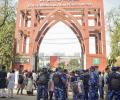
A fresh plea has been filed in the Supreme Court challenging the constitutional validity of the Waqf (Amendment) Act, 2025, claiming it was a "blatant intrusion" into the rights of a religious denomination to manage its own affairs in the matter of religion. The plea, filed by Samastha Kerala Jamiathul Ulema, argues that the amendments would distort the religious character of Waqfs and irreversibly damage the democratic process in their administration. Several other petitions have been filed in the apex court challenging the validity of the bill, including those by Congress MP Mohammad Jawed, AIMIM president Asaduddin Owaisi, and AAP MLA Amanatullah Khan.

Law Minister Ravi Shankar Prasad on Saturday hinted that the Narendra Modi government will rework on a constitutional amendment bill introduced by the previous dispensation which seeks to give the executive a say in appointment of judges.

Union Home Minister Amit Shah has announced a significant increase in Lok Sabha seats for the five southern states following delimitation, countering misinformation and clarifying the timeline for women's reservation implementation.
The Lok Sabha passed the Waqf (Amendment) Bill, 2025, with the ruling NDA defending it as beneficial for minorities while the opposition called it "anti-Muslim". All amendments moved by the opposition were rejected and the bill was passed with 288 votes in favor and 232 against. Union Minorities Affairs Minister Kiren Rijiju asserted that India is the safest place in the world for minorities, refuting claims of their insecurity.

'For the rest of his tenure, people will start with the assumption that even Modi can be forced to bow down'

Prime Minister Narendra Modi will address the nation tonight at 8.30 PM, a day after a bill to implement women's reservation in legislatures was defeated in the Lok Sabha.

The BJP is significantly increasing its digital engagement with young people on Instagram, led by Prime Minister Narendra Modi and several Union ministers, in response to the NEET-UG paper leak controversy and subsequent student protests. This strategic shift aims to counter the narrative and communicate government actions on examination reforms.
West Bengal Chief Minister Mamata Banerjee criticised Prime Minister Narendra Modi's purchase of 'jhalmuri' during a campaign stop, alleging it was a staged event for cameras. She also accused the BJP of aiding Independents from the minority community and criticised the Election Commission over voter roll revisions.
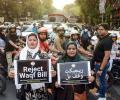
The Congress party announced its intention to challenge the constitutionality of the recently passed Wakf (Amendment) Bill, 2024 in the Supreme Court. AICC general secretary Jairam Ramesh stated that the party will "very soon" file a petition, citing concerns about the bill's impact on constitutional principles. Ramesh highlighted the Congress's ongoing legal challenges against other legislation, including the Citizenship Amendment Act (CAA), amendments to the Right to Information (RTI) Act, and changes to the Conduct of Election Rules. He emphasized the party's commitment to defending the Constitution's principles, provisions, and practices.

The Chhattisgarh government has introduced a bill aimed at preventing religious conversions through force, inducement, or misrepresentation, sparking opposition and debate in the state assembly.

The woman who confronted BJP workers during a protest in Mumbai's Worli area last month has criticised all political parties for disregarding the general public.

Congress leader Rahul Gandhi, who made "number 16" jibe at the treasury benches during his speech in Lok Sabha on Friday on three new bills, refused to elaborate on it in his brief interaction with reporters and said "it is a puzzle" and he "won't tell the answer just like that".
The bill which seeks to put in place a mechanism to hold simultaneous elections in the country has a provision for situations when election to an assembly cannot be held with those of Parliament.

Opposition parties allege the Modi government is attempting to turn India into a 'dictatorship' with the introduction of three Bills that seek to provide for removal of the prime minister, chief ministers and ministers arrested on serious charges, and vowed to oppose it 'tooth and nail'.

Prime Minister Narendra Modi has accused opposition parties of obstructing the passage of the women's reservation bill in Parliament, alleging they have crushed the dreams of women and prioritised selfish politics over national progress.
Senior Congress leader Shashi Tharoor criticised the government's decision to link women's reservation with the expansion of Parliament, calling delimitation a 'political demonetisation'. He argued that women's reservation should be implemented immediately based on existing parliamentary strength.
